ÇAPABOT®

AI-powered smart in-row hoeing machine

98%
Detection accuracy
On lettuce and squash, over four months of field testing
2 - 4 m
Working width
A 2 m main profile; each piece added at the ends is 50 cm
250 ms
Blade open-close time
Lettuce, squash
Verified crops

How it works

Intended use Mechanical hoeing of the weeds growing within the crop row in row-sown vegetable farming, without harming the crop.

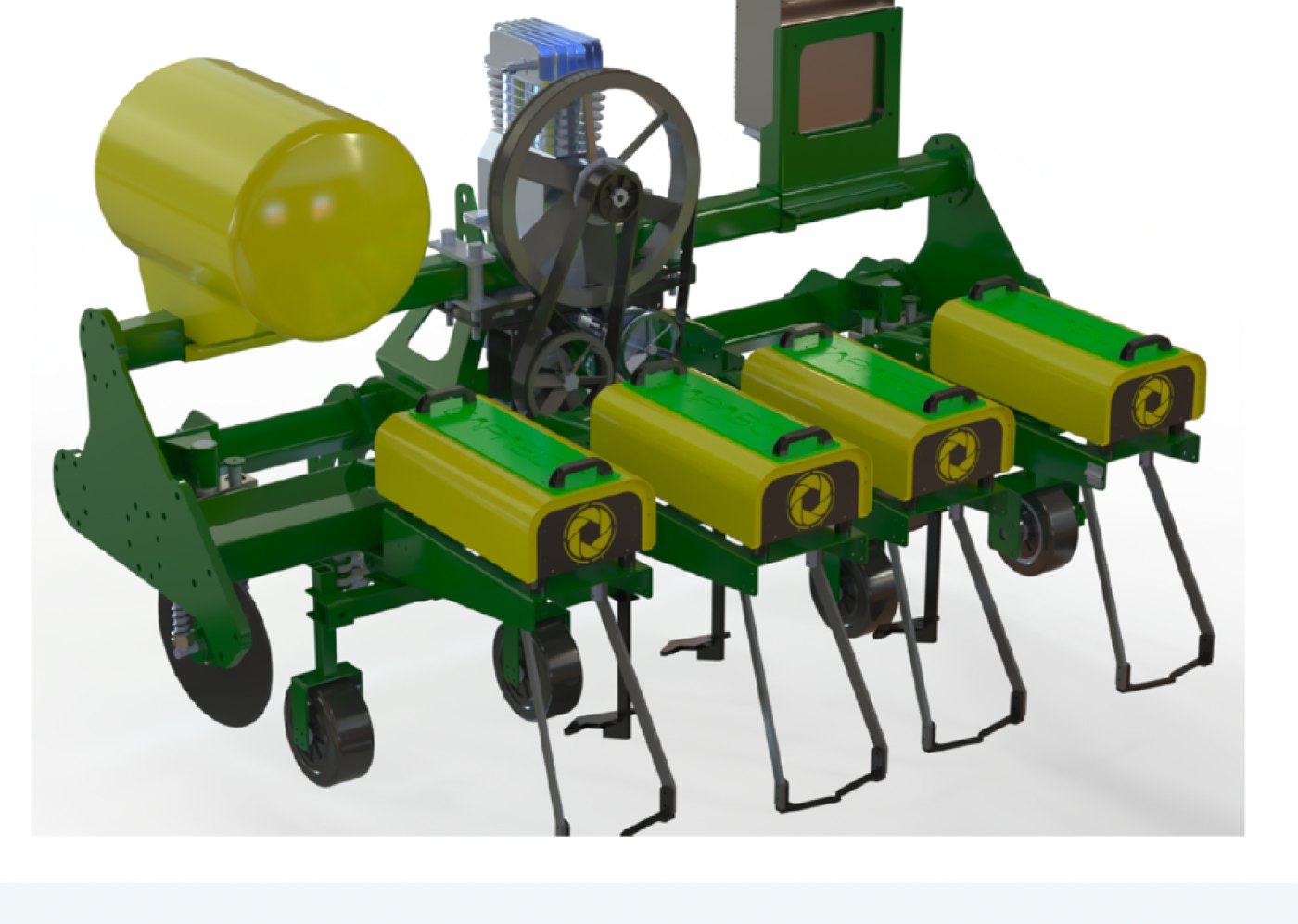
ÇAPABOT attaches to the tractor's rear three-point linkage. A compressor driven by the tractor's power take-off stores compressed air in an air tank.

There is one hoeing module per row. A global shutter camera on the module images the plants, SEMRUG's AI model identifies the crop, and the pneumatic system opens and closes the hoeing blades around it.

Weeds within the row are hoed while the crop is left untouched. The ground between the rows is taken by the optional sweep blades, so both jobs finish in the same pass.

How the design evolved

A problem seen in the field, and the change made to answer it.

The field problem found with version 1

Fixed-height modules over uneven ground.

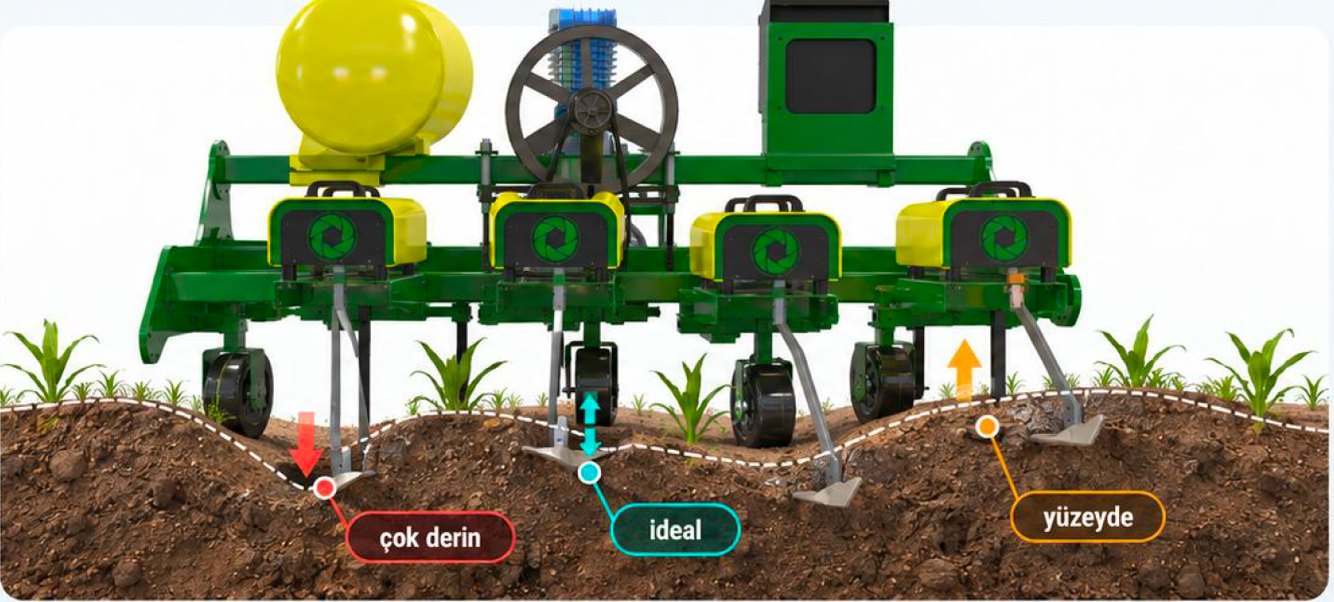
Field ground is not always level. In version 1 the mechanism housings ran at a fixed height, so over uneven ground some blades cut too deep while others rose towards the surface or left the soil altogether.
The field problem found with version 1

Fixed-height modules

Every mechanism housing runs at the same height.

Varying blade depth

Over uneven ground the blades do not hold a consistent working depth.

Uneven hoeing quality

Some stretches are worked too hard, others not enough.
Independent modules on a parallelogram linkage

Each mechanism housing works to the ground beneath it.

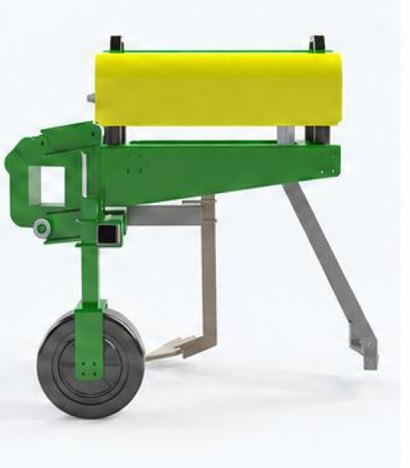
In version 2 every hoeing module hangs from the toolbar on a parallelogram linkage and follows the ground on its own gauge wheel.

The aim is to hold each module's working depth steady over uneven ground.

Independent modules on a parallelogram linkage

Free to move independently

Each housing was given independent travel on the vertical axis.

Kept parallel to the ground

The parallelogram holds the housing parallel to the ground as it works.

Steadier, more consistent work

Every module now takes the ground under itself as its reference.

In-row and inter-row in one pass

The modules clear the weeds growing on the row and the sweeps clear the ground between them, both in the same pass.

Automatic disc steering

Camera-guided row following on sloping ground, independent of the tractor.

So that the machine does not drift when the tractor does, version 2 was given a way to steer itself. The deviation the camera sees becomes a command to a pneumatic cylinder that angles a pair of sprung discs; the discs bite into the soil and pull the frame back onto the row.

The three-point hitch is left free to move sideways, so the discs' steering effect can reach the frame.

Automatic disc steering

Sensing

The cameras measure the deviation from the plant row.

Angle calculation

The direction, size and rate of change of the deviation are assessed.

Correction

A 5/3 valve is pulsed to set how far the cylinder moves.

Free hitch

Lateral freedom at the three-point hitch lets the discs steer the frame.

A platform that scales to your row count

What version 3 changed.

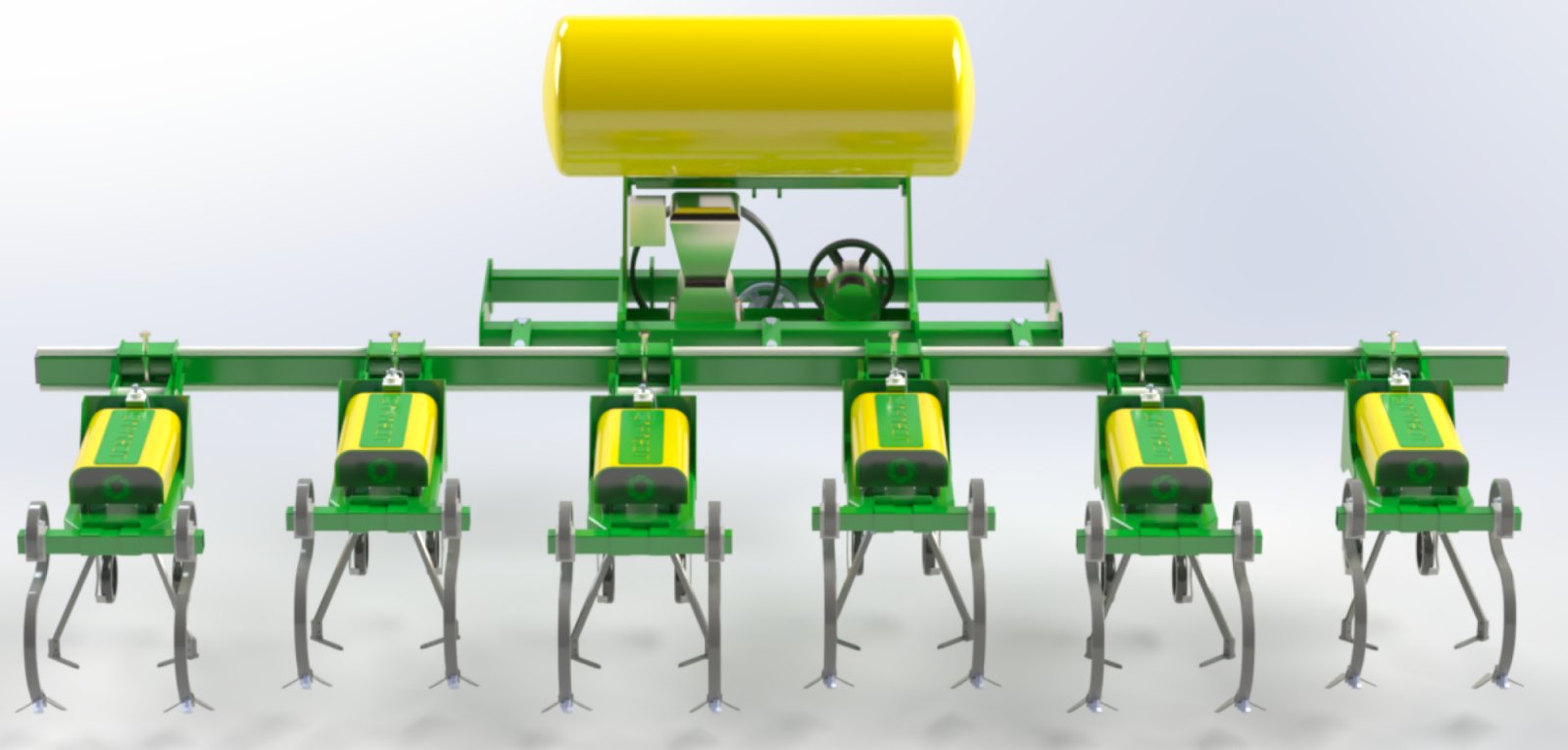
ÇAPABOT is one machine. How many rows it hoes is set by the number of modules, and there is one module per row.

On wider builds the compressor is swapped for a higher-flow model, the air tank grows to match, and the frame is extended by adding profiles. Tractor power is adequate either way.

A platform that scales to your row count

Built to the row count

The number of modules follows the rows in your field - one module per row.

The air system scales with it

A wider build gets a higher-flow compressor and a larger air tank.

The frame extends with added profiles

Going wider does not need a new frame; profiles are added to the existing one.

Row following by shifting the profile

Version 3 follows the row by sliding the profile the modules hang from, rather than by steering discs.

Suits different row spacings

The modules clamp onto a shared toolbar and are positioned to your planting layout.

A more rigid, more compact mechanism

Version 3 stiffened the carrier and reworked the mechanism housing and the tillage layout.

Sheet-clad profile frame

The carrier was made stiffer.

A smaller mechanism housing

The box was reduced in size and weight.

Rear sweep, removable

The sweep does the finishing pass and comes off when it is not wanted.

Technical specifications

Mounting and drive

Mounting Tractor rear three-point linkage
Drive Tractor power take-off (PTO), 540 rpm
Air source Compressor, 590 L/min at 1100 rpm Four-row build; wider builds use a higher-flow compressor
Air tank capacity 100 L
Actuation Pneumatic cylinder-driven hoeing blades
Gauge wheel height adjustment Set with a jack
Sweep blades Optional; hoe between the rows

Imaging and AI

Imaging One global shutter camera per module
Processor Embedded AI processor
Software SEMRUG image processing, AI and control software
Detection accuracy 98% On lettuce and squash, over four months of field testing
Verified crops Lettuce, squash

Performance

Blade open-close time 250 ms

Dimensions and power

Working width 2 - 4 m A 2 m main profile; each piece added at the ends is 50 cm
Main carrier profile 2 m, extended with 50 cm pieces

Row count

One machine, built to your row count. These are two examples; each row gets one hoeing module.

4-row

4 hoeing modules

Four hoeing modules, four rows. The configuration validated in the field.

6-row

6 hoeing modules

Six hoeing modules, six rows, with a higher-flow compressor, a larger air tank and the frame extended by adding profiles.

Registration and development

Trademark registration no
2026 007303
Design registration no
2026 002119
Development
Developed by SEMRUG under a TÜBİTAK 1507 project.

ÇAPABOT® is a registered trademark of SEMRUG.

Want to see it in your field?

Leave a demo request and our team will work out the right configuration for your crop with you.

Request Demo