ÇAPABOT V2: holding working depth over uneven ground
When a field observation sends you back to the drawing board
The first version of ÇAPABOT ran for four months in lettuce and squash. The AI side behaved as expected: it identified the crop with 98% accuracy, and the pneumatic arms opened and closed around each plant in 250 milliseconds.
The problem was not in the software. It turned up in the soil.
Fields are not flat
A field looks flat from the edge. From under the machine it plainly is not: mounds, hollows, tractor wheel ruts, irrigation ridges.
In version 1 all four hoeing modules were bolted to a single toolbar at a fixed height. The toolbar takes its height from the tractor, so when the ground rose or fell the modules could not follow it. In a single pass you got three different behaviours at once:
- A module over a hollow drove its blades too deep
- A module on level ground worked at the right depth
- A module over a mound lifted its blades clear of the soil
One machine, over-working and not working at the same moment.
What that means in practice
On a hoe, depth is the quality of the work. A blade running too deep moves more soil than it should and comes closer to the crop's root zone. A blade riding on the surface passes over the weed without cutting it, and that stretch of row stays uncleared.
So even with the camera and the model doing their job, the mechanical side could spoil the result. Detection accuracy on its own is not enough.
What changed in version 2
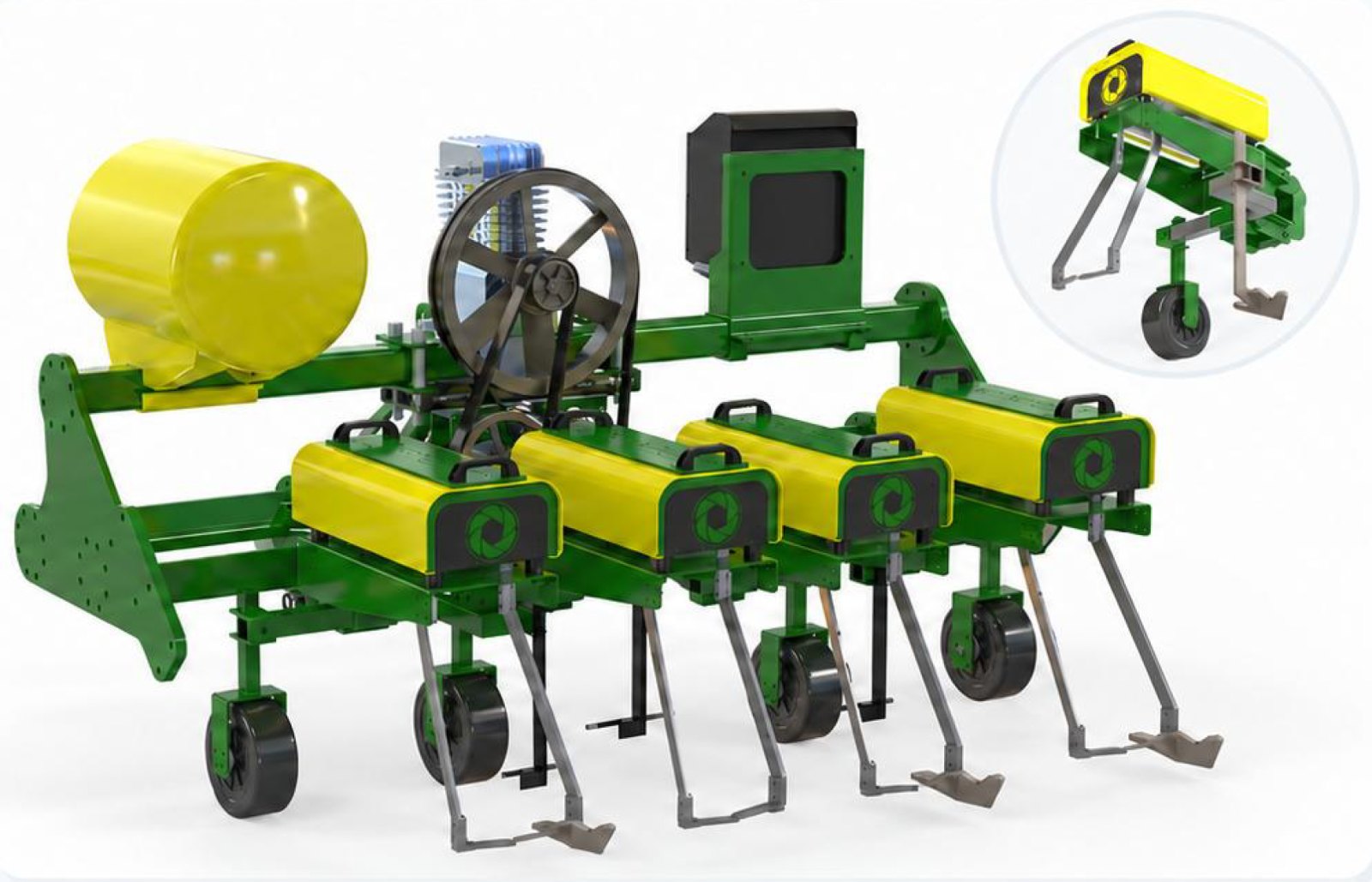
In the second version we separated each hoeing module from the toolbar.
A parallelogram linkage. The module no longer hangs from a fixed clamp but from a parallelogram arm set. The useful property of that geometry is that it does not change the module's angle as the arm travels up or down. Whether the module rises or drops, it stays parallel to the ground. With a simple hinge it would tip forward or back on every movement and the blade angle would go with it.
A gauge wheel per module. Each module now rides on its own wheel and takes the ground directly beneath it as its reference. What the neighbouring module is doing no longer matters. Four modules, four separate ground profiles.
Sweep blades. The hoeing modules clear the weeds growing on the row; the optional sweeps take the ground between the rows. Both jobs finish in the same pass - no hand hoeing on the row, no separate run for the inter-row.
All three serve one aim: holding every module's working depth steady over uneven ground.
Depth solved, the row still open
The modules now followed the ground, but the machine itself still went wherever the tractor went. On sloping land, when the tractor drifted a few centimetres off the row, every module drifted with it.
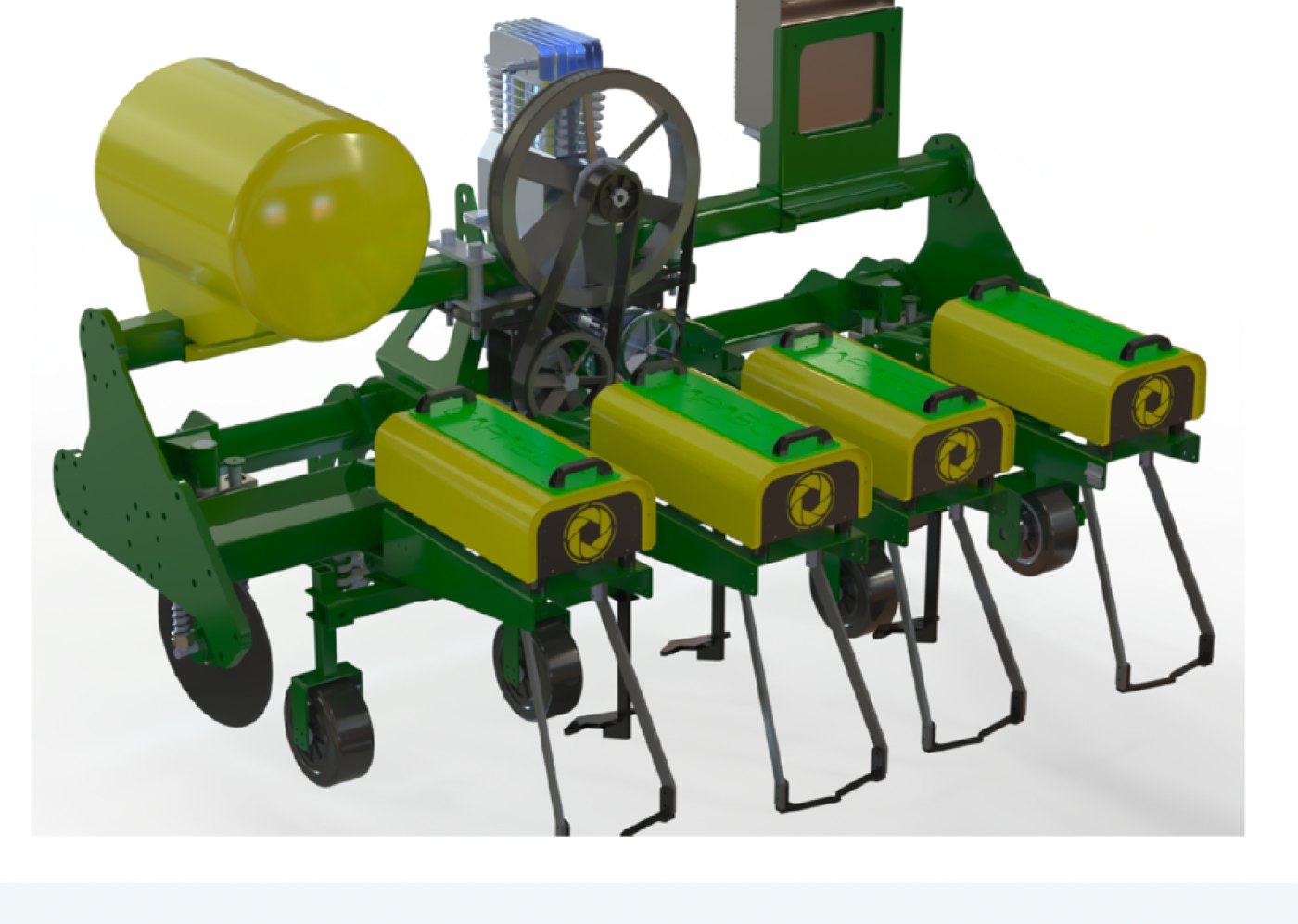
So version 2 was given a way to steer itself. The deviation the camera sees becomes a command to a pneumatic cylinder that angles a pair of sprung discs; the discs bite into the soil and pull the frame back onto the row. The three-point hitch is left free to move sideways - without that, what the discs pull on would never reach the frame.
Version 3 went one step further and stopped the row count being fixed as well. That has a post of its own.
To be straight about it
We have no field measurement for version 2 to share yet. The 98% and 250 ms above come from the version-1 trial and apply to lettuce and squash. Version 2's mechanics were designed to fix this problem; how well they fix it is something we will measure in the field next season, and we will publish that the same way.
What comes next
ÇAPABOT is one machine, and you decide how many rows it hoes. One hoeing module per row; the four-row and six-row builds are ready.
If you would like to see the machine in your own field, leave a demo request and we will work out the right configuration for your crop together.